
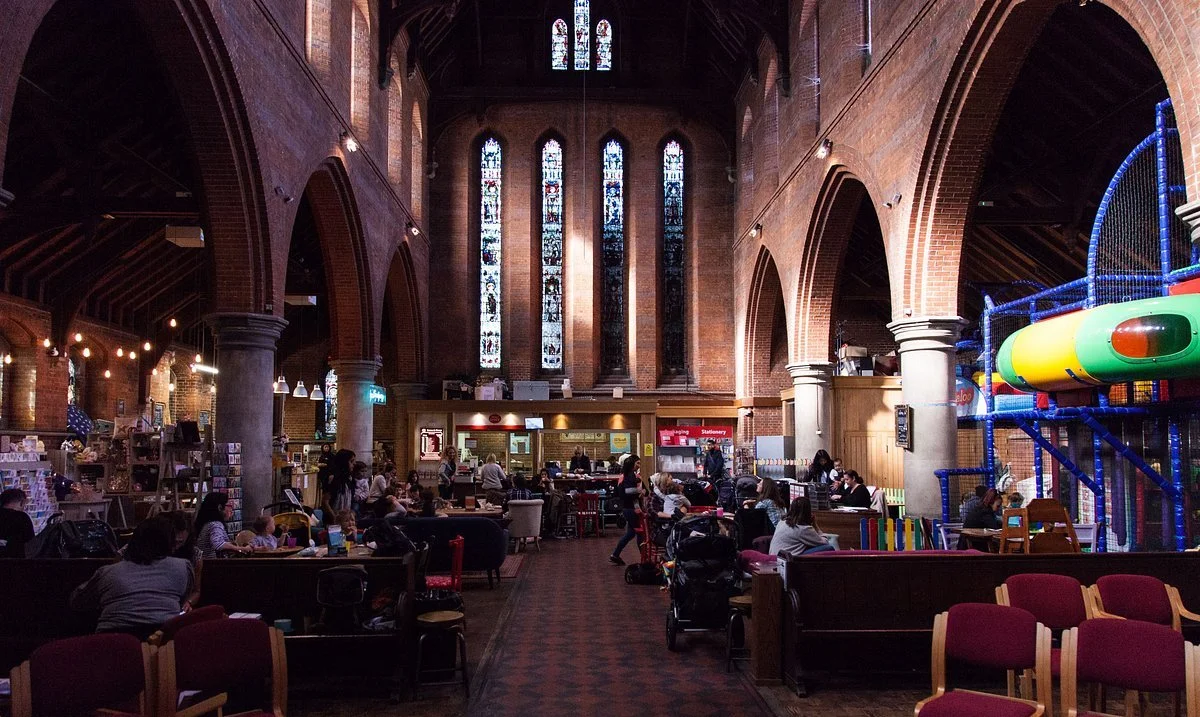
It has been almost a year since I started mulling over writing about places of worship—specifically England-based churches—and their future role within both rural and urban communities. Without necessarily realising it, this topic feels rather zeitgeisty. Throughout the year, I have been loosely keeping a note of the things shaping my thoughts.
Art, Architecture and Memory
The origin of this interest can probably be traced back to Liverpool in the summer of 2025. While Katie and I were doing some initial research in and around the Albert Dock, we stumbled happily across Liverpool’s Art Biennial. While trekking around, we kept encountering incredible work, often in non-traditional venues—a derelict church, a community centre in Chinatown—all of which was free-to-access.
For me Elizabeth Price’s film Here We Are at The Black-E made a notable impression. Born out of an observation that religious buildings reflect both social history and migratory patterns, Price’s filmic archive overlays oral testimony with photography of beautiful, modernist Catholic churches in and around the North West. So many of these buildings were created in response to a displaced Catholic diaspora, many originally from Ireland and Southern Europe, who were looking to foster stronger bonds and communal gathering spaces in unfamiliar places. As the exhibition notes point out, “over a thousand Catholic churches were built in Britain between 1955–1975”. Price’s film acts as a visual archive, memorialising the churches, highlighting their architectural flair and, in doing so, paying tribute to the communities who established them alongside new roots.
A Changing Congregation
It may not come as a surprise that many of these heritage buildings are facing challenging futures. Dwindling numbers in church attendance can be seen in the latest British Social Attitudes survey findings, with regular attendance among under-35s dropping to under 4%, and weekly visitation among those over the age of 70 also declining at an unprecedented rate—down by half to around 9% compared to ten years ago.
While the changing emphasis on religious conviction in everyday life is a subject that absolutely deserves attention, to surmise that reduced church-going means religious buildings have less relevance in civic society would be to undermine and diminish the vital role these spaces often play.
Exploring this further, the latest edition of the nomadic architectural biennial Manifesta 16, held in Germany’s Ruhr region, featured the open call "This is not a church", which invited artists to reactivate vacant modernist and historic churches. Over the course of the summer, artists and researchers transformed empty and unused churches into sites of community, cultural practice, conversation, and understanding, offering everything from installations, exhibitions, and cooking sessions through to club nights, family activities, and weaving workshops. As curator Michael Kurtz remarked in his introductory curatorial essay: "these landmarks, once central to neighbourhood life for many, have become symbols of our diminished public realm: of social atomisation and the loss of collective experience." Through its ambitious programme of urban research-led curation, churches were brought back into the centre of civic life.
Of course, this reduction in regular church-going also has a knock-on effect on the ability of these remarkable heritage sites to be sustainable. The National Churches TrustGiving Every Church a Voice survey revealed that 5% of the UK’s churches will either 'definitely' or 'probably' close as places of worship by 2030. This equates to around 38,500 churches, chapels, and meeting houses (roughly 20,000 of which are listed)—a worrying trend exacerbated by the reality that over 3,500 have closed in the last decade alone. One in ten respondents also reported that their church building required urgent repair within the next 12 months, with roof repairs, guttering, drainage, and heating identified as the most pressing issues. A complex combination of increased energy costs, stretched incomes, smaller volunteer networks, and costly historic materials is creating a particularly challenging time for those willing churches to maintain their civic role.
Navigating a New Funding Landscape
Over the last twenty years, the Listed Places of Worship Scheme (LPWG) delivered huge benefits and financial relief to churches grappling with historic buildings, spiralling repair costs, limited manpower and stretched budgets. It enabled eligible parishes to claim an automatic 20% Value Added Tax rebate on qualifying repair bills, providing an average boost of around £23 million in savings per year nationwide.
However, as of 31 March this year, the scheme was terminated and replaced by the Places of Worship Renewal Fund, established by the Department for Culture, Media and Sport (DCMS) and administered by Historic England. Rather than focusing on tax relief, this new scheme has a total pot of £92 million distributed over a four-year period—in real terms, a slight reduction in overall funding value. A significant change is that the funding pot has become competitive rather than de facto administered, meaning applications that respond to funding requirements have to be both developed and considered within set funding rounds.
While critics of this change have highlighted that it places a heavier financial burden on churches (especially those in rural and more deprived areas), perhaps what is most significant is the additional resources now needed to build and communicate a compelling case for investment. Places of worship will now be required to balance the urgency of repairs with a fuller picture of site civic value, community need and (in many cases) a commitment to diversification—drawing churches closer to the operational models of cultural organisations applying for funding from Arts Council England and the DCMS. As Historic England’s guidance details “priority will be given to projects in areas of England with the greatest need for investment, and those that bring the most community benefit... Grants ranging from £10,000 to £1,000,000 will be awarded for capital works that keep buildings safe, open and in public use.”
Yet, there is a clear appetite among many churches across England to embrace this evolution. The Church Times highlighted that 85% of parishes would expand community support if they had more resources. Countless examples already exist of religious spaces successfully diversifying to house activities supporting local communities—including foodbanks, Fairtrade shops, post offices, and cafés. Many provide mental health support and warm spaces, offering a refuge from the cold and a chance to belong. The Giving Every Church a Voice survey notes that more than half of surveyed churches are used by other organisations at least once a week:
76% host community groups
56% distribute food
49% host youth groups
34% offer mental health support
Reinventing the Parish: Communities in Action
Real-world examples of this diversification are plentiful. For instance, St James's Church in West Hampstead successfully stepped in to save and rehome a local post office threatened with closure, establishing The Sherriff Centre—an independent social enterprise that cross-funds a commercial café, soft play area, and commercial hire space alongside Anglican worship. Similarly, St Luke’s Church in Liverpool, affectionately known as the Bombed Out Church, reclaimed a structurally compromised, roofless shell and transformed it into an open-air cultural venue, performance space, and community garden.
Large-scale pivoting towards a broader conception of community value takes time, energy, and effort. Fortunately, a wealth of free tools and resources is available online to help churches communicate and amplify their community outreach, ranging from the National Lottery Heritage Fund’s guidance on building an activity plan and Historic England’s Places of Worship Renewal Fund FAQs, to the Social Value Calculator, advice on the co-location of community businesses, and toolkits for community need audits.
Ultimately, the story of our churches is no longer just about pews and parishes; it is about the holistic, cumulative role that these spaces can and should play in our civic life - now and in the future. As congregations shrink and structural challenges mount, many places of worship are at a crucial crossroads. We can watch these historic landmarks quietly fade from our communities, or we can champion their reinvention as vibrant, multi-functional anchors of local life. Through embracing new funding models, forging partnerships with the cultural sector and leaning into their enduring role as community hubs, England's churches can secure a sustainable future: as our relationship with faith changes, our need for spaces that bring us together has never been greater.